

Last updated: · Figures checked against their sources.
Quick Summary How long does customs clearance take? A compliant, pre-filed shipment usually clears in a few hours to about three business days, according to Carra Globe’s 2026 shipment data, while physical inspections can add 1 to 20 days. In Saudi Arabia the declaration must be filed 48 hours before arrival, per ZATCA.
This Freight Club guide answers the timing question importers in Egypt and the Gulf ask most: typical clearance times by shipping mode, what the official rules in Egypt, Saudi Arabia and the UAE require, what tracking statuses mean, why shipments get stuck, and six steps that shorten the wait.
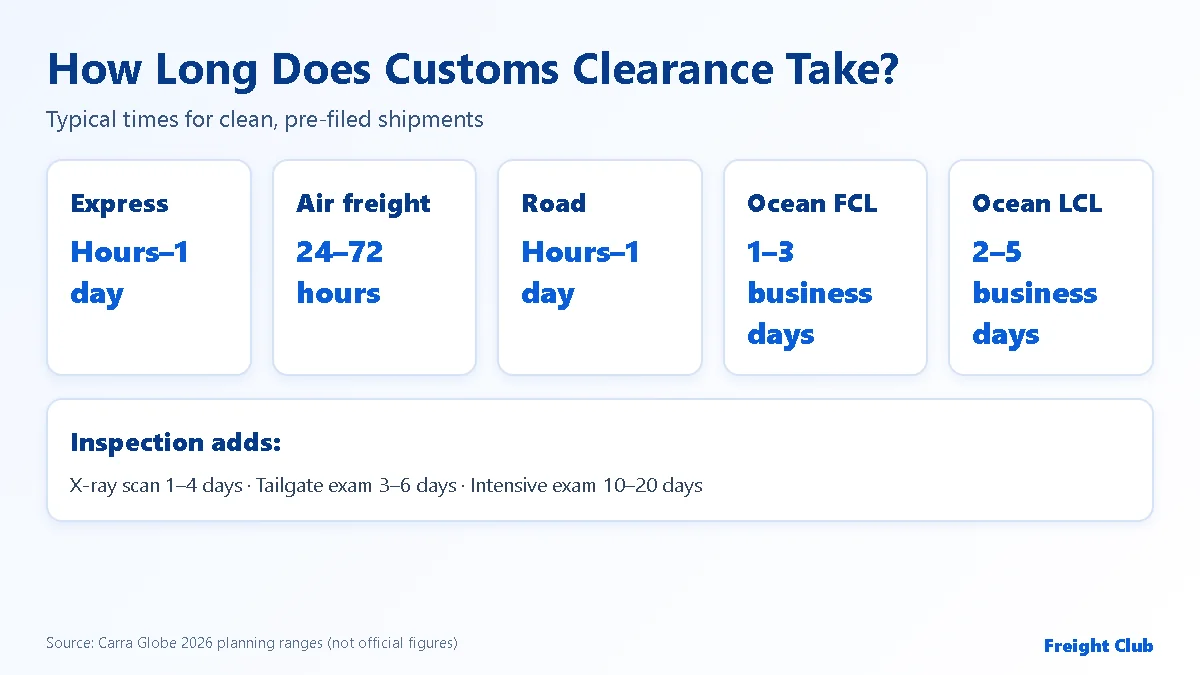
Customs clearance time for a shipment with complete, pre-filed documents is usually hours for express parcels and one to five business days for sea cargo. Carra Globe’s July 2026 baselines, built from more than 2,300 of its own UK, EU and US shipments, are summarised below; the company calls them “industry planning ranges, not official figures” (Carra Globe).
| Shipping mode | Typical customs clearance time |
|---|---|
| Express courier | A few hours to 1 day |
| Air freight | 24 to 72 hours |
| Ocean FCL (full container) | 1 to 3 business days |
| Ocean LCL (shared container) | 2 to 5 business days |
| Road | Hours to 1 day |
Other planners publish similar ranges: GoFreight’s March 2026 US guide gives 4 to 24 hours for air cargo and 1 to 3 business days for ocean containers. There is no universal number, as iContainers notes, because the destination, the goods and the declaration all change the result.
A package usually stays in customs clearance for a few hours to two or three business days, and most parcels clear within 24 to 48 hours, according to Pango (August 2026). The same source says it takes one to two weeks when duties are unpaid or paperwork is missing.
Customs clearance time in Egypt and the Gulf is driven by pre-arrival filing rules, not by a single published deadline. The World Customs Organization’s Time Release Study measures exactly this interval, “from the arrival of goods to their physical release”, and each country’s rules decide how much of it you control.
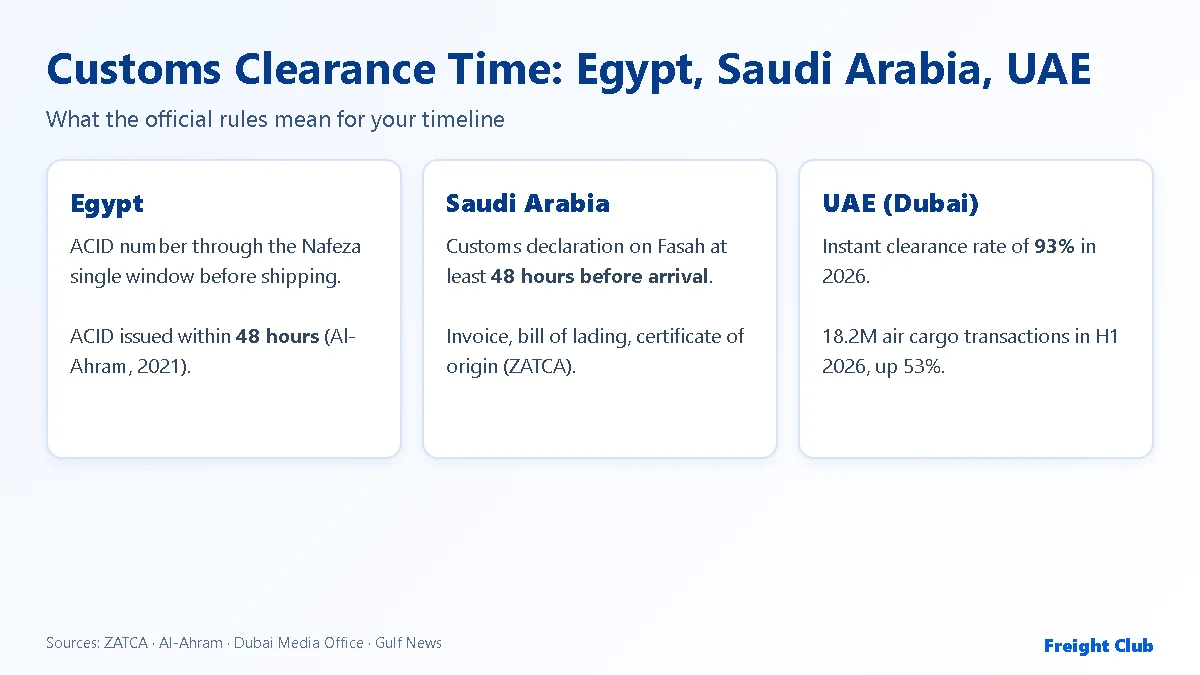
Customs clearance in Egypt depends on the ACID number and the Nafeza single window: Al-Ahram (August 2021) reported that importers receive the ACID within 48 hours and quoted an exporters’ representative expecting release within three days rather than seven or 10. Nafeza describes its systems as aimed at reducing customs release time. Freight Club explains registration in ACID Number in Egypt, and the wider process in customs clearance in Egypt.
Customs clearance in Saudi Arabia starts before the ship docks: ZATCA requires importers to complete the customs declaration on the Fasah platform at least 48 hours before the shipment arrives, with a commercial invoice, bill of lading and certificate of origin, per its Import Instructions (updated August 2026). A late declaration is the most common avoidable delay there; see our guide to freight forwarders in Saudi Arabia.
Customs clearance in Dubai is largely instant for compliant declarations: Dubai Customs maintained an instant clearance rate of 93% in 2026, according to the Dubai Media Office (19 July 2026). Its air cargo centers processed 18.2 million transactions in the first half of 2026, up 53%, as Gulf News reported. For services and brokers, read customs clearance services in the UAE.
“Customs clearance in progress” means customs has received your shipment’s declaration and is reviewing it; the goods are not yet released. The status is normal for 24 to 48 hours on most parcels, per Pango. For a fuller customs clearance meaning, see what customs clearance services are.
To check customs clearance status, use the tracking number on the carrier or forwarder’s portal, or ask your broker for the declaration number. In Saudi Arabia the declaration itself is filed on Fasah, as described in ZATCA’s instructions.
A package gets stuck in customs when documents are missing or inaccurate, duties are unpaid, the goods need another agency’s approval, or customs selects it for inspection. Inspections add the most time: Carra Globe’s planning ranges are 1 to 4 days for an X-ray scan, 3 to 6 days for a tailgate exam and 10 to 20 days for an intensive exam (Carra Globe, 2026).
A package stuck in customs for 2 weeks or a month is rarely waiting on customs alone; it is usually waiting on the importer. Every extra day can add storage, demurrage and detention charges once the free time ends, as Freight Club explains in port charges and demurrage and detention fees.
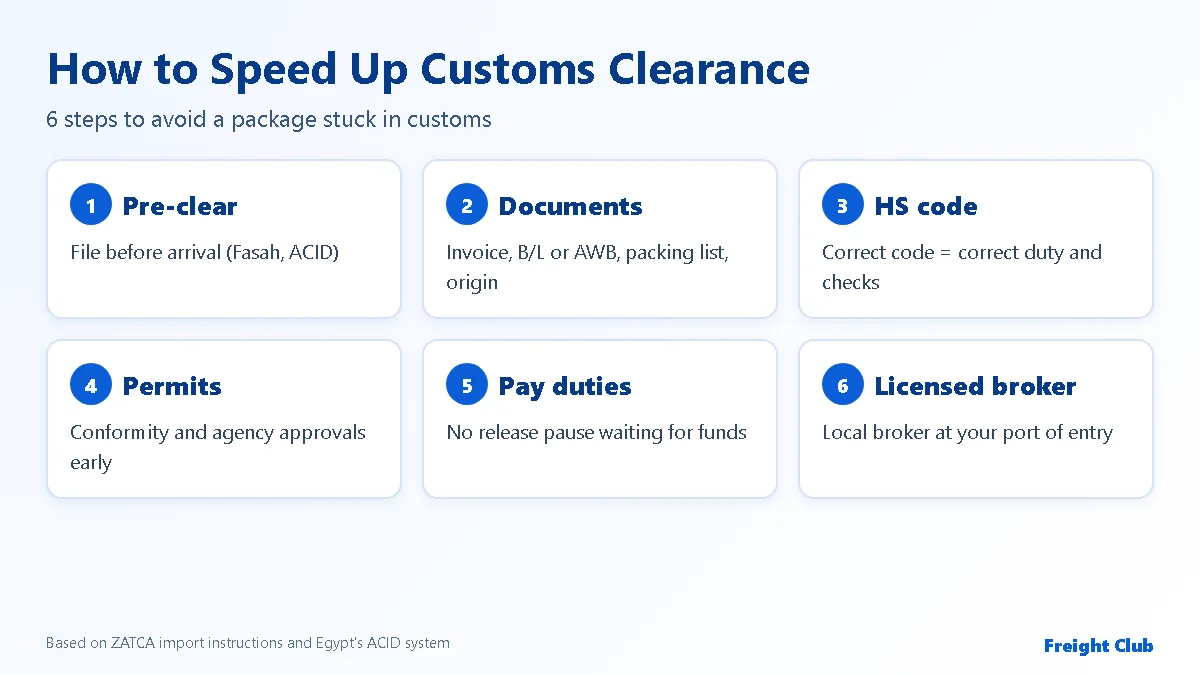
Fast customs clearance comes from filing before arrival and leaving customs nothing to question. ZATCA’s 48-hour pre-arrival rule (ZATCA) and Egypt’s ACID pre-registration show the pattern: the work happens before the cargo lands.
For the HS code step, use the HS code lookup and import duties guide. For the broker step, compare Egypt customs brokers or these customs clearance offices listed on Freight Club: Elkayan for Customs Clearance, Nour4Customs and Pharaohs for Customs Services in Egypt, and Sennar Horizoin in Saudi Arabia.
Air freight clears customs faster than sea freight. Typical times are 24 to 72 hours for air versus 1 to 3 business days for an FCL container and 2 to 5 for LCL, in Carra Globe’s baselines. LCL is slower because shared containers are unpacked and checked as one consignment.
Clearance is only one part of how long international shipping takes; transit time and inland delivery add to it. If your cargo can wait, compare costs with the Freight Club freight rate calculator, and read LCL vs FCL shipping before choosing a shared container.
Delays also raise the bill, so read our breakdown of customs clearance fees before you ship.
A licensed customs broker at your port of entry is often the fastest way to cut clearance time.
A compliant, pre-filed shipment should clear in a few hours to about three business days; express parcels are fastest and LCL sea cargo is slowest, according to Carra Globe‘s 2026 planning ranges.
Most parcels clear within 24 to 48 hours, but a package can stay in customs for one to two weeks when duties are unpaid or paperwork is missing, and longer if it is selected for an intensive inspection, according to Pango and Carra Globe.
After customs clearance is completed, delivery depends on the carrier or forwarder’s inland transport and your location; ask them for the delivery estimate once the status changes to cleared.
It means customs is reviewing the declaration, documents and value of your shipment, and the goods are not yet released. No action is needed unless the status changes to held or the carrier asks for information.
File the declaration before arrival, send complete and accurate documents, use the correct HS code, obtain permits early, pay duties promptly and use a licensed customs broker at the port of entry.
Contact the carrier or your customs broker, ask for the exact reason for the hold, send any missing document or payment immediately, and track storage charges so the delay does not become costly.
Air freight is faster both in transit and in customs: air cargo typically clears in 24 to 72 hours, while ocean FCL takes 1 to 3 business days and LCL 2 to 5, based on Carra Globe‘s 2026 data.
Most customs clearance delays are avoidable because they start with the importer, not with customs.
This guide relies on official customs authorities, government media and named industry data.
Disclaimer: This guide is general information from Freight Club, not customs or legal advice. Clearance times vary by country, port, goods and inspection selection, and rules change by official decision, so confirm current requirements with the customs authority or a licensed customs broker before shipping.
Need your shipment cleared faster?
Browse customs clearance offices
Add your customs clearance company