

Last updated: 11 November 2026 · All figures checked against their sources.
Customs clearance services are the work a licensed customs broker or freight forwarder does to move your goods legally across a border: preparing documents, classifying products, paying duties and arranging inspections and release. In Egypt they cover both imports and export clearance services. This Freight Club guide explains each step, with official sources.
Most importers know the import side, but exporters face a different set of rules and registrations. Below you will find what a clearance service includes, how import and export clearance differ in Egypt, the documents you need, and how to choose a clearance office from our directory.
They are the paperwork and procedures needed for customs to release your goods, handled for you by a customs broker or forwarder. A good clearance service saves time, avoids fines and keeps cargo moving.

A full clearance service usually includes:
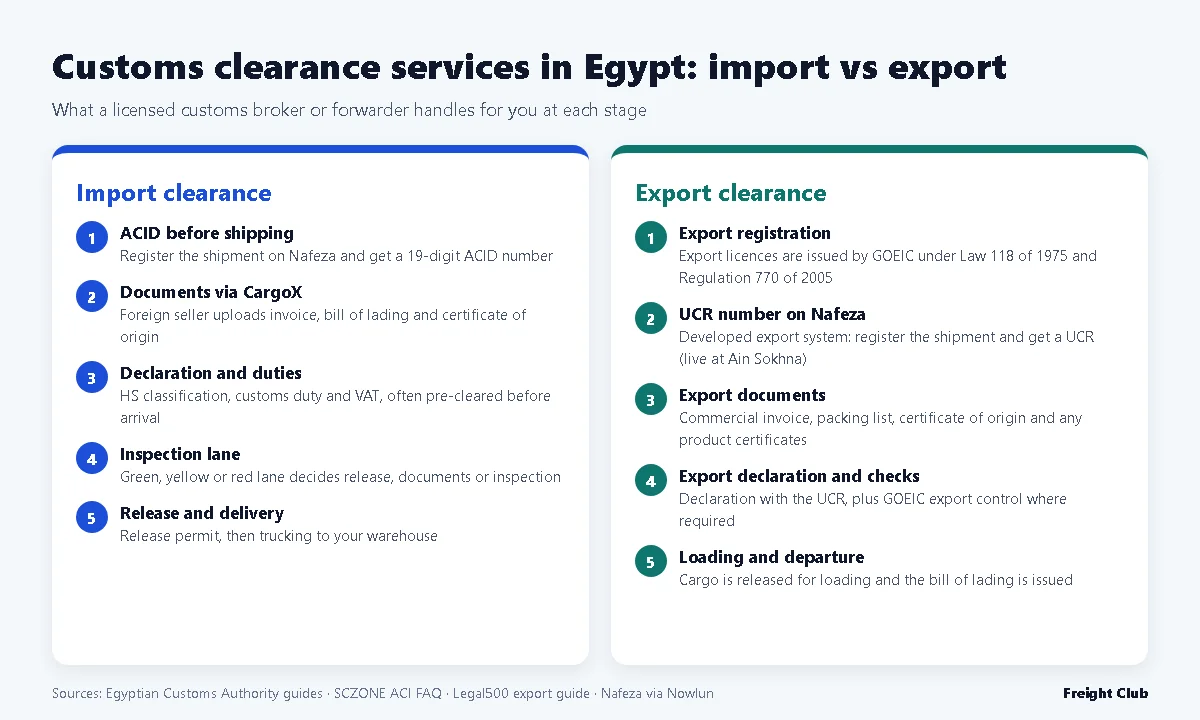
Import clearance in Egypt starts before the goods are shipped, with advance registration on the Nafeza platform. Every shipment needs a 19-digit ACID number, which must appear in the bill of lading, according to the official ACI FAQ from the Suez Canal Economic Zone.
For a step-by-step walkthrough of import clearance, see our guide to customs clearance in Egypt.
Export clearance services prepare and file everything needed for goods to leave Egypt legally. They cover export licensing, documents, the export declaration and any product checks.
Export activity in Egypt is governed by Import and Export Regulations Law No. 118 of 1975 and its Executive Regulation No. 770 of 2005, and the General Organization for Export and Import Control (GOEIC) is the authority that issues and renews the required export licences, according to this Legal500 guide to exporting from Egypt. Check current requirements and fees directly with GOEIC.
Customs is also digitising exports. Under the developed export system on Nafeza, an exporter registers the shipment and obtains a UCR number before submitting the export declaration. Nafeza says the system currently operates at Ain Sokhna Port and will be extended gradually to other ports, as reported by Nowlun.
Import clearance focuses on duties, taxes and product compliance for goods entering Egypt. Export clearance focuses on licensing, origin and destination requirements for goods leaving.
| Point | Import clearance | Export clearance |
|---|---|---|
| Key registration | ACID on Nafeza before shipping (source) | Export licence from GOEIC; UCR on Nafeza where available (source) |
| Main payments | Customs duty and VAT | Export fees and service charges, usually no import duty |
| Main documents | Invoice, bill of lading, certificate of origin, packing list, bank Form 4 | Invoice, packing list, certificate of origin, destination certificates |
| Inspections | Risk lanes and inspection by regulators | Export control for regulated products |
| Who does it | Importer’s customs broker or forwarder | Exporter’s customs broker or forwarder |
The core set is the commercial invoice, packing list, transport document and certificate of origin. Regulated products need extra certificates or approvals.

Choose a licensed office with experience in your product, port and direction of trade, import or export. Ask for a written list of fees before you start.
These customs clearance offices in Egypt are listed in the Freight Club directory:
See every office in the customs clearance offices category, and read our guide to customs brokers in Egypt. Clearing goods in the Gulf? See customs clearance services in the UAE and freight forwarders in Saudi Arabia.
They include checking documents, classifying goods by HS code, filing the customs declaration, paying duties and taxes, attending inspections and obtaining release, handled by a licensed broker or forwarder.
Export clearance services prepare and file the licences, documents and export declaration needed for goods to leave a country legally. In Egypt, export licensing is handled by GOEIC under Law No. 118 of 1975.
Under Nafeza’s developed export system, exporters register the shipment and get a UCR number before filing the export declaration. The system currently runs at Ain Sokhna Port and is being extended to other ports, according to Nowlun.
Yes. Every shipment to Egypt needs a 19-digit ACID number obtained on Nafeza before shipping, according to the official ACI FAQ.
Importers and exporters can handle procedures themselves if they are registered and have the required access, but most businesses use a licensed broker because of the documentation, systems and port procedures involved.
Browse the Freight Club customs clearance offices directory, shortlist offices that handle your product and port, and compare written fee quotes.
Whether you import or export, good customs clearance services keep your cargo legal, on time and free of avoidable fines. Use the steps above to prepare, then compare licensed clearance offices in the Freight Club directory.