

Last updated: · Rules checked against the law texts and official sources.
Quick Summary A customs broker clears your goods through customs; a freight forwarder moves them from origin to destination. In Egypt, Article 51 of Customs Law 207 of 2020 bars anyone from clearing goods for others without a customs license valid for two years, per Andersen’s translation. Many importers hire both, or one firm offering both.
This Freight Club guide explains what each provider does, how the rules differ in Egypt, Saudi Arabia and the UAE, when an importer needs one or both, and how to compare their fees before signing.
A customs broker is a licensed intermediary who prepares, signs and submits customs declarations and completes clearance procedures on behalf of the goods’ owner. Egypt’s Customs Law 207 of 2020 defines the role in exactly those terms, as “licensed by the Authority to prepare, sign, and submit customs declarations” (Andersen translation of Law 207).
A customs clearance agent, customs agent and customs broker are the same profession under different local names. Saudi Arabia’s ZATCA defines the customs broker as a licensed person who prepares, signs and submits customs declarations, per its customs clearance page. In practice, a customs clearance agent classifies goods, calculates duties, files the declaration and attends inspections.
A freight forwarder is the party that organises the physical movement of goods from origin to destination: booking space with carriers, consolidating cargo, arranging transport documents and coordinating delivery. FIATA, the international federation of freight forwarders’ associations, describes the forwarder as “the party who ensures that internationally traded goods move from point of origin” to destination (FIATA).
A forwarder does not own ships or planes; it buys capacity from shipping lines and airlines. Freight Club explains that split in the difference between a freight forwarder and a shipping line.
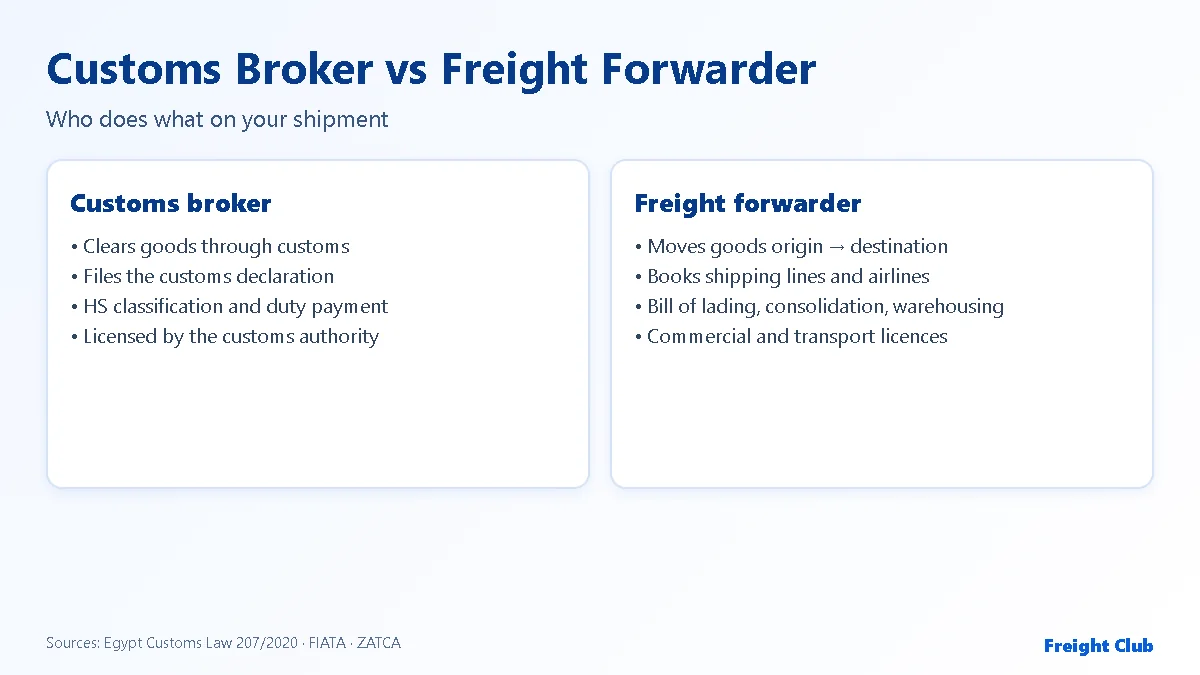
The difference between a customs broker and a freight forwarder is the problem each solves. The broker handles the legal release of goods at the border; the forwarder handles their transport. The table compares them on six points, using the Egyptian definition in Law 207 and the forwarder role set out by FIATA.
| Point | Customs broker | Freight forwarder |
|---|---|---|
| Main job | Clears goods through customs | Moves goods from origin to destination |
| Works with | Customs authority and regulators | Shipping lines, airlines, truckers, warehouses |
| Key documents | Customs declaration, HS classification, duty payment | Bill of lading or air waybill, booking, packing list |
| Licence | Customs broker licence from the customs authority | Commercial and transport licences (varies by country) |
| When you pay | Per declaration or per shipment | Per shipment, container or kilo |
| Risk it manages | Penalties, holds, wrong duties | Delays, damage, missed connections |
A licensed customs broker is required to clear goods for others in Egypt. Article 51 of Law 207 states that “No person may engage in customs clearance activities for goods belonging to others without obtaining a license from the Authority” (Andersen). Saudi Arabia licenses brokers through ZATCA, and each country sets its own term and conditions.
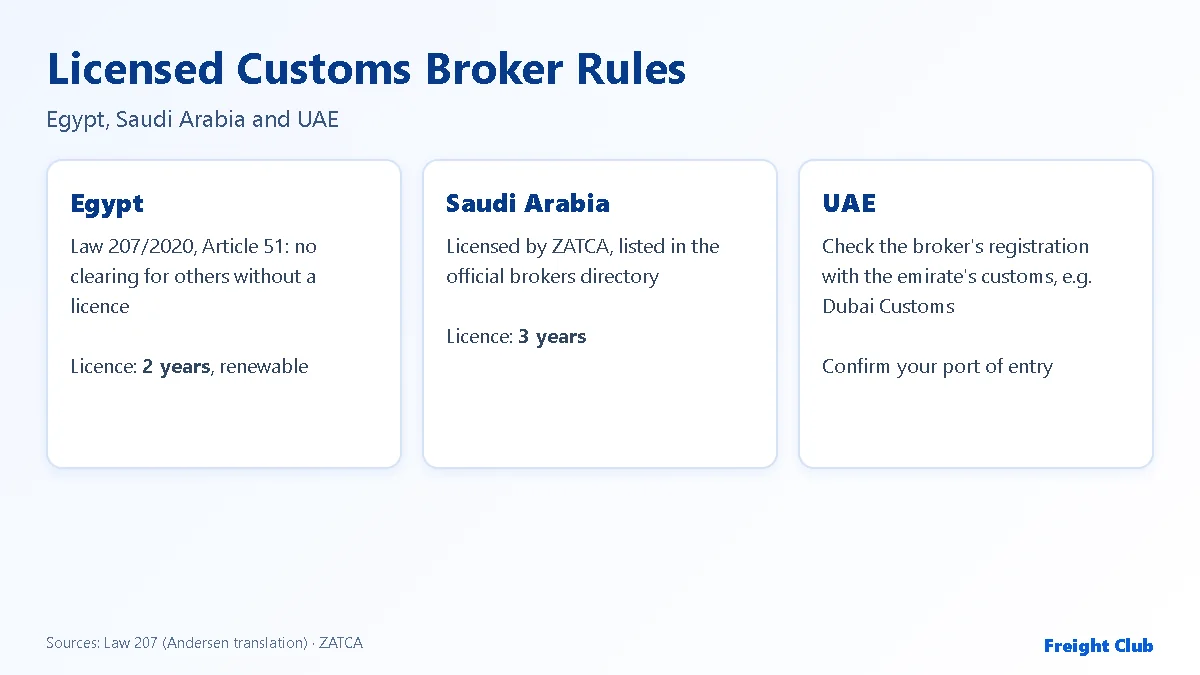
Egypt’s customs broker licence is “valid for two (2) years, renewable” and lapses if not renewed, and Article 52 requires an Egyptian national with a university qualification, according to the text of Law 207 of 2020. For the ACI system, trade.gov notes that “either the Egyptian importer, or a customs broker acting on behalf of the importer” may use the e-portal. Compare local firms in Egypt customs brokers.
Saudi customs broker licences last three years from the date of the licensing decision, and ZATCA lists every licensed broker in its official directory, per the ZATCA clearance page and brokers directory. Importers authorise a broker electronically on the Fasah platform before the 48-hour pre-arrival deadline set in ZATCA’s import instructions.
In the UAE, ask any broker for its customs registration with the emirate’s customs authority, such as Dubai Customs, and confirm it covers your port of entry. The UAE’s duty structure is explained in our guide to customs clearance services in the UAE.
Most importers need both roles on every international shipment: someone to move the cargo and someone licensed to clear it. The real choice is whether to hire two providers or one firm that offers freight forwarding and customs brokerage together, because in Egypt clearing for others legally requires the broker licence under Article 51.
Yes, many firms offer freight forwarding and customs brokerage services together, holding a broker licence alongside their forwarding operation. In Saudi Arabia, several companies on Freight Club list both on their profiles: Bader International Shipping and Everest for International Shipping in Riyadh, and Nawara Transport and Freight in Jeddah.
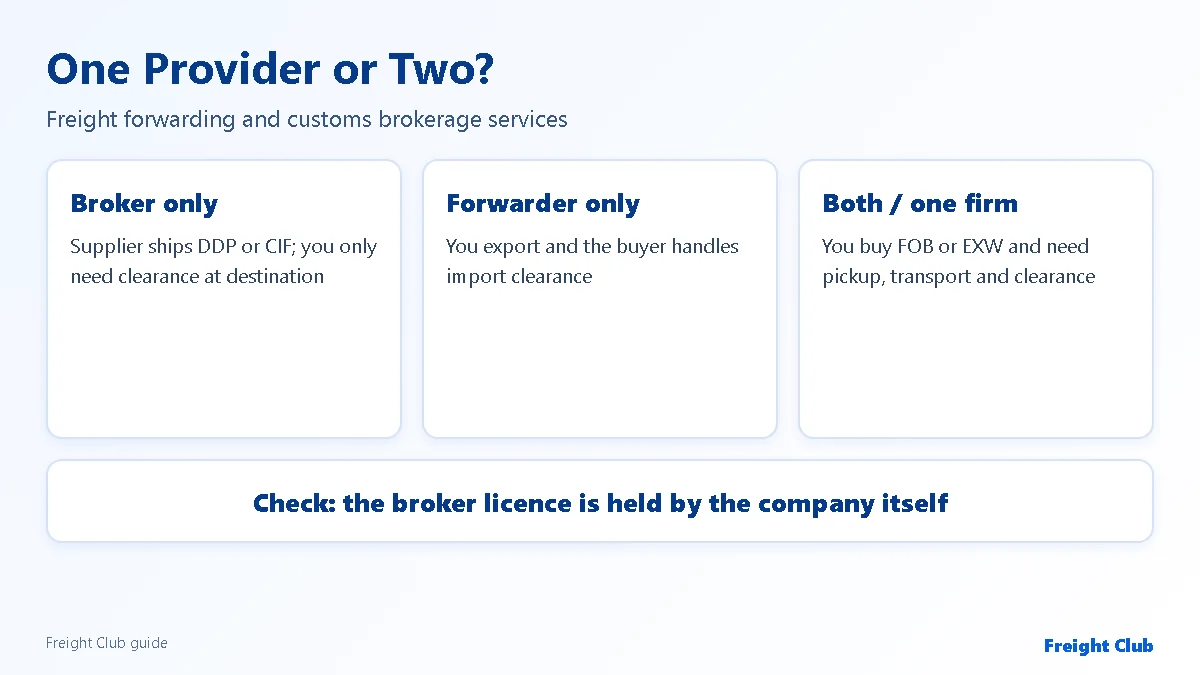
A single provider means one contact and fewer handovers, but check that the broker licence is held by the company itself, not by a subcontractor. For specialist clearance in Egypt, Freight Club lists offices such as Elkayan for Customs Clearance and Nour4Customs, and forwarders in freight forwarders in Egypt and freight forwarders in Saudi Arabia.
Customs broker fees are charged per declaration or per shipment, while freight forwarder charges are built from freight, handling and documentation per container or per kilo. Neither has an official tariff, so the government duties should match between quotes while service fees differ, as Freight Club explains in customs clearance fees. ZATCA’s broker e-service page lists no fee for the service itself (ZATCA).
Ask both providers for written quotes on the same shipment, with duties, VAT, broker fee, freight and port charges on separate lines. Delays raise both bills, so check how long customs clearance takes on your route.
No. A freight forwarder organises transport; a customs broker is licensed to prepare and submit customs declarations for others. Some companies hold both roles, but they are separate services and, in Egypt, clearing goods for others requires a customs licence under Article 51 of Law 207, per Andersen’s translation of Law 207.
A customs agent handles the customs declaration, duties and inspections at the border, while a freight forwarder books carriers and moves the goods from origin to destination.
A customs clearance agent is a licensed customs broker who prepares, signs and submits customs declarations and completes clearance procedures on behalf of the owner of the goods.
If someone else is clearing your commercial goods, that person must be licensed; in Egypt, Article 51 of Law 207 of 2020 prohibits clearing goods for others without a customs licence, per Andersen’s translation of Law 207. Most importers use a broker to avoid penalties and delays.
It is a combined service in which one company both arranges transport and clears the goods through customs, so the importer deals with a single provider from pickup to delivery.
Your customs broker is the licensed person or company named on your customs declaration or authorised by you on the customs platform, such as Fasah in Saudi Arabia; ask your forwarder if you did not appoint one directly.
Choosing the wrong broker costs more than choosing the wrong forwarder, because declaration errors bring penalties.
This guide relies on the law texts, customs authorities and the international forwarders’ federation.
Disclaimer: This guide is general information from Freight Club, not legal or customs advice. Licensing rules and conditions change by law and executive regulation, so confirm a broker’s current licence and scope with the customs authority before you appoint them.
Find the right partner for your next shipment
Browse customs brokers
Browse freight forwarders
Add your company