
Last updated: · Definitions checked against U.S. maritime law (46 U.S.C. 40102), the Federal Maritime Commission, FIATA and the ICC Incoterms® 2020 rules.
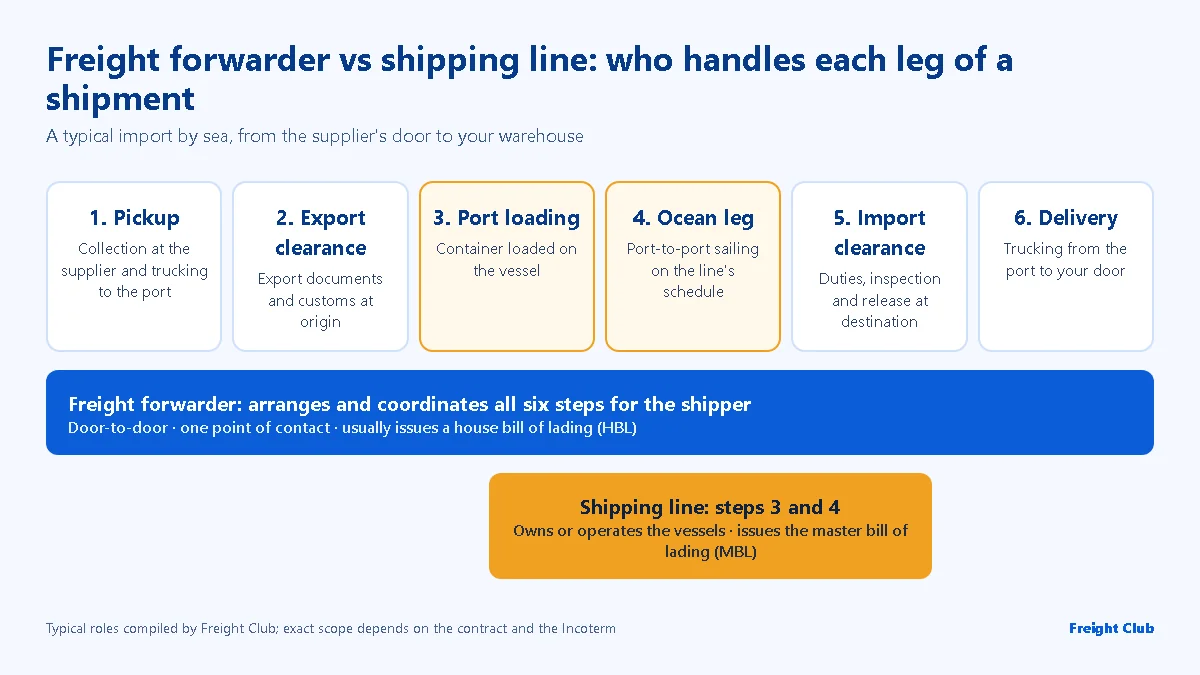
Quick Summary Freight forwarder vs shipping line comes down to ownership and scope. A shipping line owns or operates the vessels and moves containers port to port under a master bill of lading. A freight forwarder owns no ships; it books space with lines and organises the whole door-to-door shipment, including clearance and trucking, for the shipper.
This Freight Club guide compares the two roles side by side, explains who issues the house and master bills of lading, shows where NVOCCs and shipping agents fit, and helps importers and exporters in Egypt and the Gulf decide whether to book directly with a shipping line or through a freight forwarder.
A shipping line is the carrier that sails the ship, and a freight forwarder is the organiser that arranges the whole trip for the cargo owner. U.S. maritime law, one of the few places these roles are defined in statute, calls the line an “ocean common carrier”, meaning “a vessel-operating common carrier” (46 U.S.C. 40102).
So what is a shipping line in practice? It is the company that runs container vessels on fixed routes and schedules, sells space on them and is responsible for the cargo while it is at sea. That is the full shipping line meaning in logistics; for the history and services of the major carriers, read our guide to shipping lines and international trade.
What is a freight forwarder? FIATA, the international federation of forwarders, describes it as “the party who ensures that internationally traded goods move from point of origin to point of destination” (FIATA). That is why freight forwarding vs shipping is not a choice between two equal services: the forwarder usually buys the shipping from the line and adds everything around it.
The difference between freight forwarder and shipping line shows up in nine practical areas, from who owns the ships to who you call when a container is delayed. The table sets out the shipping line vs freight forwarder comparison for a typical sea shipment.
| Point | Shipping line | Freight forwarder |
|---|---|---|
| Assets | Owns or charters vessels and containers | Usually owns no ships; buys space from lines |
| Scope | Port to port, on its own network | Door to door, across lines and transport modes |
| Who it works for | Any shipper or forwarder that books space | The exporter or importer, as its organiser |
| Transport document | Master bill of lading (MBL) | House bill of lading (HBL) or acts as agent |
| Customs clearance | Not included | Arranged in-house or through a customs broker |
| Inland trucking and storage | Rarely, and only on some routes | Arranged as part of the shipment |
| Cargo size | Full container loads (FCL) mainly | FCL and part loads (LCL) through consolidation |
| Pricing | Ocean freight plus line surcharges | One quote that includes its service margin |
| Point of contact | Line customer service, per booking | One contact for the whole shipment |
Put simply, freight forwarder vs carrier is a split between the party that organises and the party that physically moves the goods. A forwarder may use several carriers on one shipment, for example a truck to the port, a vessel across the sea and another truck at the destination.
No, a freight forwarder is not a shipping company in the sense of a vessel operator, although people often use the words loosely. In the shipping company vs freight forwarder comparison, the shipping company (or ocean carrier) runs the ships, while the forwarder buys space from it and manages the shipment for you. The ocean carrier vs freight forwarder line blurs only when a large forwarder also runs its own trucks or warehouses; it still relies on the lines for the sea leg.
A shipping line is one type of carrier, so the two terms overlap but are not identical. The difference between shipping line and carrier is scope: “carrier” covers any company that physically transports goods, including airlines, trucking firms and rail operators, while “shipping line” means an ocean carrier running scheduled vessel services.
The shipping line issues the master bill of lading, and the forwarder or NVOCC issues the house bill of lading to its own customer. In the house bill of lading vs master bill of lading split, the MBL is the line’s contract with the forwarder, who appears as shipper, and the HBL is the forwarder’s contract with you, the cargo owner.
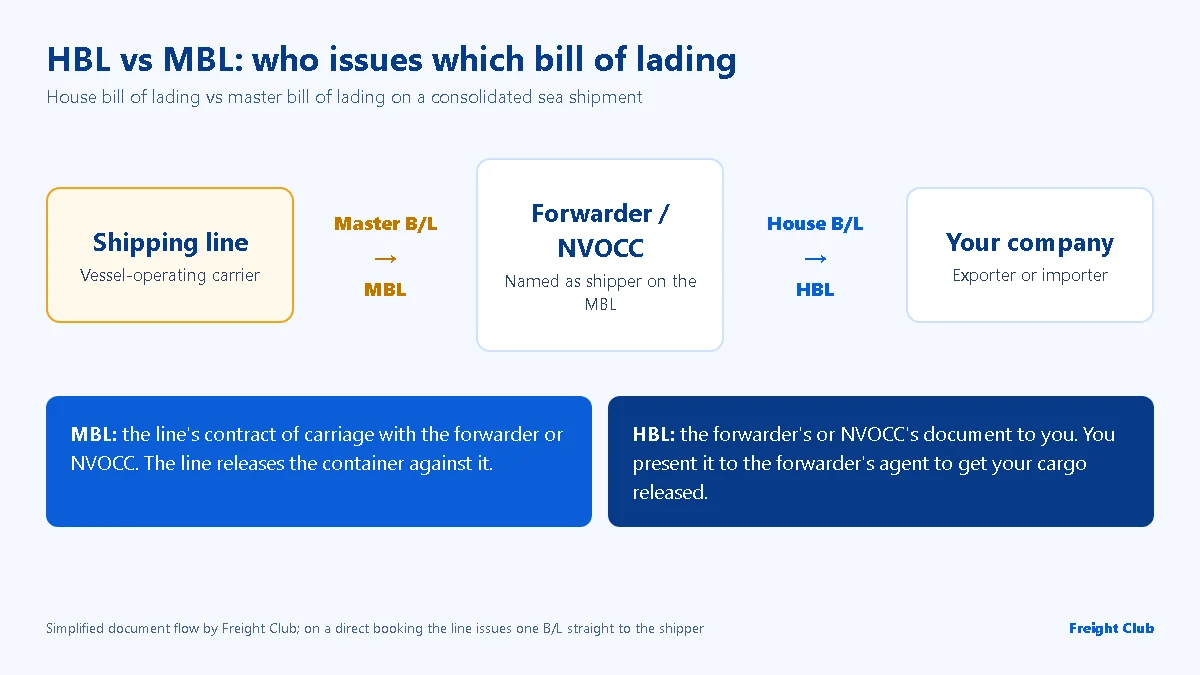
HBL vs MBL matters at release. On a consolidated shipment the line releases the container to the forwarder’s agent against the MBL, and you collect your goods from that agent against your HBL and its charges. If you book directly with the line, there is usually a single bill of lading issued straight to you. Our guide to the bill of lading explains the document’s three functions in detail.
An NVOCC sits between the two: it acts as a carrier to you but does not operate ships. U.S. law defines a non-vessel-operating common carrier as a common carrier that “does not operate the vessels by which the ocean transportation is provided” (46 U.S.C. 40102). So what is NVOCC in plain terms? A company that buys container space from lines in bulk, resells it under its own name and issues its own house bill of lading.
The difference between NVOCC and freight forwarder is the role each takes in the contract. The NVOCC takes carrier responsibility for the sea transport and issues its own bill of lading, while a pure forwarder books space on behalf of the shipper as its agent. In the United States both are licensed as ocean transportation intermediaries: the Federal Maritime Commission’s licensing office “reviews all applications for OTI Non Vessel Operating Common Carrier (NVOCC) and OTI Ocean Freight Forwarder licenses” (FMC).
In practice, nvocc vs freight forwarder vs shipping line is often one company wearing two hats. Many forwarders in Egypt and the Gulf also act as NVOCCs on their main lanes, which is why their quotes come with their own house bills of lading.
A VOCC is a vessel-operating common carrier, meaning a shipping line, and an NVOCC is a carrier without ships. The VOCC vs NVOCC difference is therefore ownership of the vessel: both can issue bills of lading and quote ocean freight, but only the VOCC controls the ship, its schedule and its equipment.
A shipping agent works for the shipping line in a port, while a freight forwarder works for the cargo owner. In the shipping agent vs freight forwarder comparison, the agent represents the line’s interests locally: it handles vessel calls, issues delivery orders, collects the line’s local charges and manages container release and return.
A shipping line agent is usually the office an importer in Egypt or the Gulf deals with to pay terminal handling charges and get the delivery order, even when the booking was made abroad. Late container return can add demurrage and detention charges, so agree on free days before the container sails. A forwarder, by contrast, chases the agent for you and passes those charges through on its invoice.
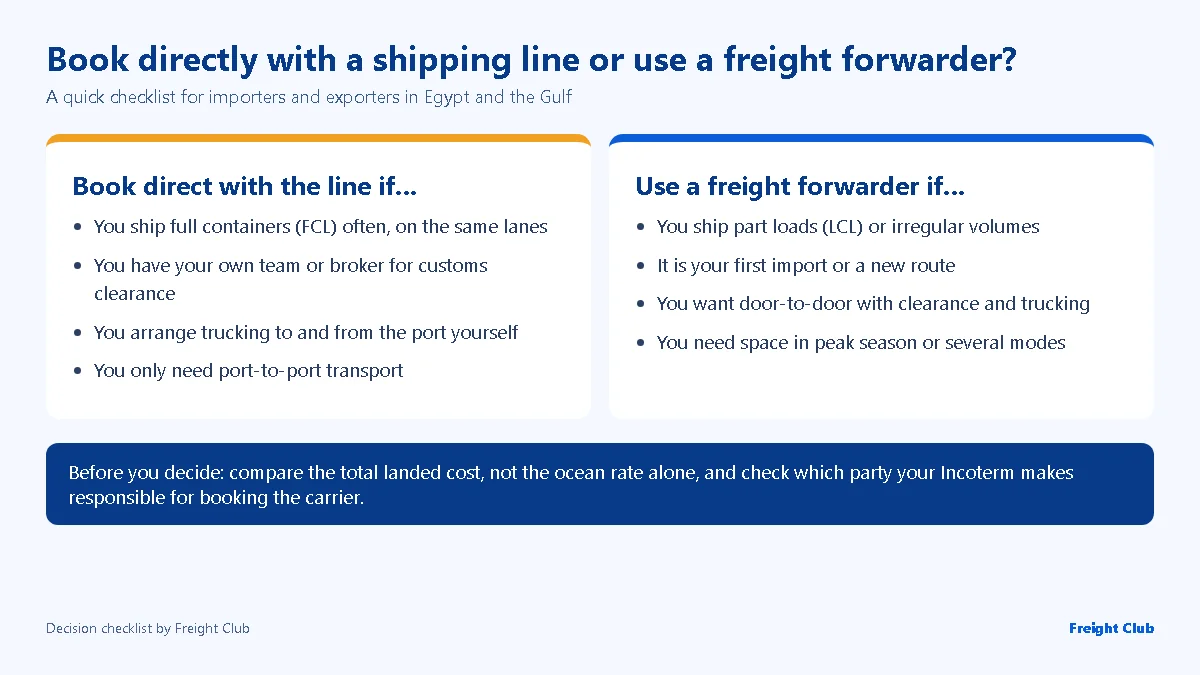
Book directly with a shipping line when you move regular full containers and can handle clearance and trucking yourself; use a freight forwarder for everything else. The book directly with shipping line or freight forwarder decision depends on volume, cargo size, in-house skills and how much of the chain you want to manage.
Answer four questions before you choose a provider. First, is the shipment FCL or LCL? Second, do you need door-to-door delivery or only port to port? Third, who has the right to book the carrier under your sales contract? The ICC’s Incoterms® rules exist to “clearly define buyer and seller responsibilities worldwide” (ICC), so check your term in our Incoterms guide or the DDP meaning guide. Fourth, who will clear the goods through customs at each end?
Freight Club lists freight forwarders, shipping lines and customs clearance offices in separate categories, so you can contact the right type of company for your shipment. Start with the freight forwarder directory, the shipping line directory and the customs clearance offices category.
For country shortlists, see our guides to freight forwarders in Egypt, freight forwarders in the UAE and freight forwarders in Saudi Arabia. If you ship by sea from Egypt, our sea freight Egypt guide and our overview of import and export companies in Egypt add the local context.
A shipping line owns or operates vessels and carries containers port to port under its master bill of lading. A freight forwarder owns no ships; it books space with shipping lines and organises the full shipment for the cargo owner, including documents, customs clearance and inland trucking.
No. An NVOCC is a non-vessel-operating common carrier: it acts as a carrier to its customers and issues its own house bill of lading, but it does not operate ships. It buys space from shipping lines, which are vessel-operating carriers.
Not exactly. An NVOCC takes carrier responsibility and issues its own bill of lading, while a freight forwarder can act only as the shipper’s agent. Many companies hold both roles, so check which one appears on your bill of lading.
The shipper is the owner or seller of the goods, usually the exporter named on the bill of lading. The freight forwarder is the service provider the shipper hires to arrange transport, documents and clearance. In shipper vs freight forwarder terms, one owns the cargo and the other organises its movement.
BL is the general term for a bill of lading. An MBL, or master bill of lading, is the specific bill a shipping line issues to the forwarder or NVOCC, while the forwarder issues a house bill of lading (HBL) to the cargo owner. On a direct booking there is usually one BL.
No. Shipping is the physical transport of goods by a carrier such as a shipping line. Freight forwarding is the organising of that transport and everything around it, including booking, documents, clearance and delivery, on behalf of the cargo owner.
A freight forwarder is also called a forwarding agent, a logistics provider or, in ocean freight, an ocean transportation intermediary. When it issues its own bill of lading it is often described as an NVOCC or a consolidator.
Most disputes between importers and their providers start with an unclear document or an unpriced local charge, so check both before the cargo sails.
This guide relies on legal definitions, regulator information and the official pages of the industry bodies below.
Disclaimer: This guide is general information from Freight Club, not legal or commercial advice. Roles, documents and charges depend on each contract and on local rules in Egypt and the Gulf, so confirm terms with your provider before you ship.
Find the right forwarder or shipping line for your next shipment