

Last updated: · Rates checked against their sources.
Quick Summary Customs clearance fees combine government charges and service charges: a customs duty on the CIF value, VAT on the value plus duty, and the broker’s and port’s fees. Duty is generally 5% in Saudi Arabia and the UAE, and 0% to 60% in Egypt, while VAT is 15%, 5% and 14% respectively, per PwC.
This Freight Club guide explains every line on a customs bill for importers in Egypt, Saudi Arabia and the UAE: what is a government charge, what is a service fee, how to calculate customs with a free estimator, who pays duties under each Incoterm, and how to cut the hidden charges that inflate the final cost.
A customs clearance fee is the total cost of getting imported goods released by customs. It combines government charges such as customs duty and import VAT with service charges from the customs broker, the port and the carrier. Duties are calculated on the CIF value (cost, insurance and freight) in Egypt, the UAE and Saudi Arabia, according to PwC’s UAE tax summary and trade.gov’s Saudi guide.
The difference matters when you compare quotes. Government charges are fixed by the tariff and tax law, so every broker should arrive at the same figure for the same declaration. Service charges are what brokers, ports and carriers compete on, and that is where customs clearance cost varies from one office to another.
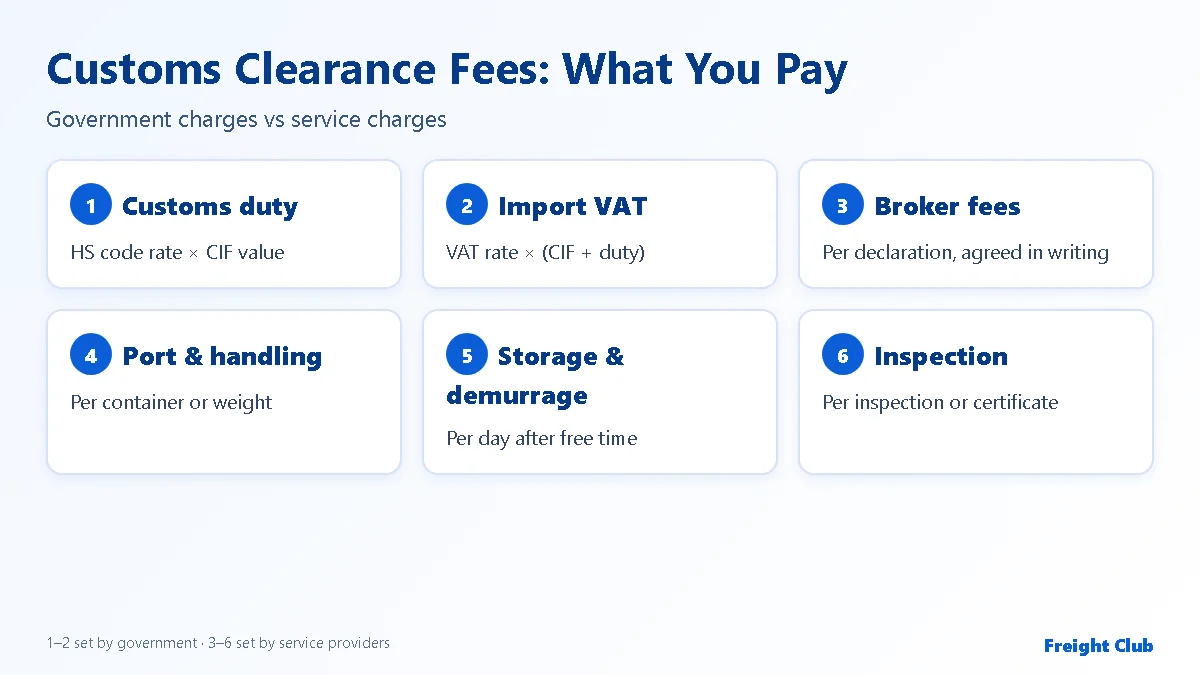
Customs clearance charges fall into six lines, and only the first two are set by the government. Saudi Arabia, for example, adds “a customs surcharge, port fees, cargo service fees, and an import inspection tax” on top of duty, as trade.gov lists.
| Charge | Who sets it | How it is calculated |
|---|---|---|
| Customs duty | Government tariff | Rate of the HS code × CIF value |
| Import VAT | Tax authority | VAT rate × (CIF value + duty) |
| Customs broker fees | Broker | Per declaration or per shipment, agreed in writing |
| Port and handling charges | Port and terminal | Per container or per weight |
| Storage, demurrage and detention | Port and shipping line | Per day after the free time ends |
| Inspection and certificates | Customs and regulators | Per inspection or per certificate |
The last two lines are the customs clearance hidden charges: they depend on time, not on the goods. Freight Club explains them in port charges and demurrage and detention fees.
How to calculate customs: multiply the CIF value by the duty rate of your HS code, then apply VAT to the CIF value plus that duty. PwC describes the Egyptian VAT base as “the invoice value CIF, the customs duty, and other taxes” (PwC Egypt), and Grant Thornton gives the same CIF-plus-duty base for Saudi Arabia (Grant Thornton).
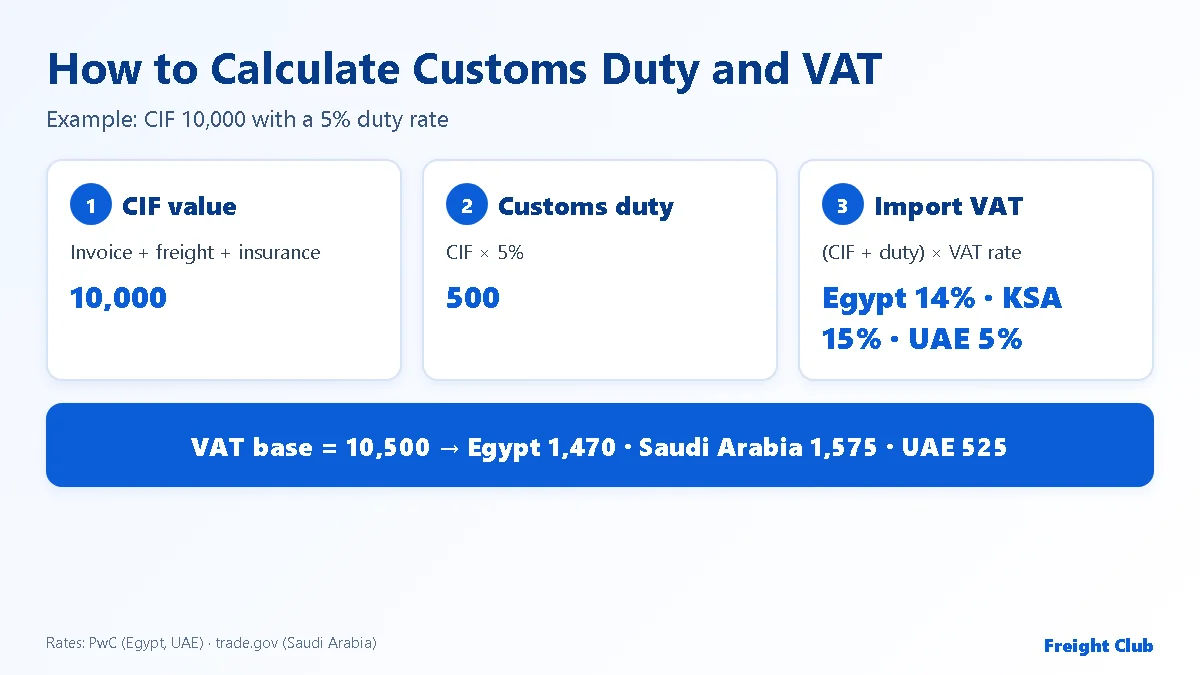
The duty rate comes from the HS code, so look it up first with the HS code lookup and import duties guide. The Freight Club estimator below uses the VAT rates published by PwC (Egypt 14%, UAE 5%) and trade.gov (Saudi Arabia 15%); it is a customs clearance fee calculator for planning, not a substitute for the official declaration.
VAT rates from PwC Egypt, trade.gov Saudi Arabia and PwC UAE.
Customs fees differ most in the duty rate: Egypt’s rates are spread widely, while Saudi Arabia and the UAE generally apply 5% to CIF value. The VAT rate then adds 14%, 15% or 5% on top, per PwC and trade.gov.
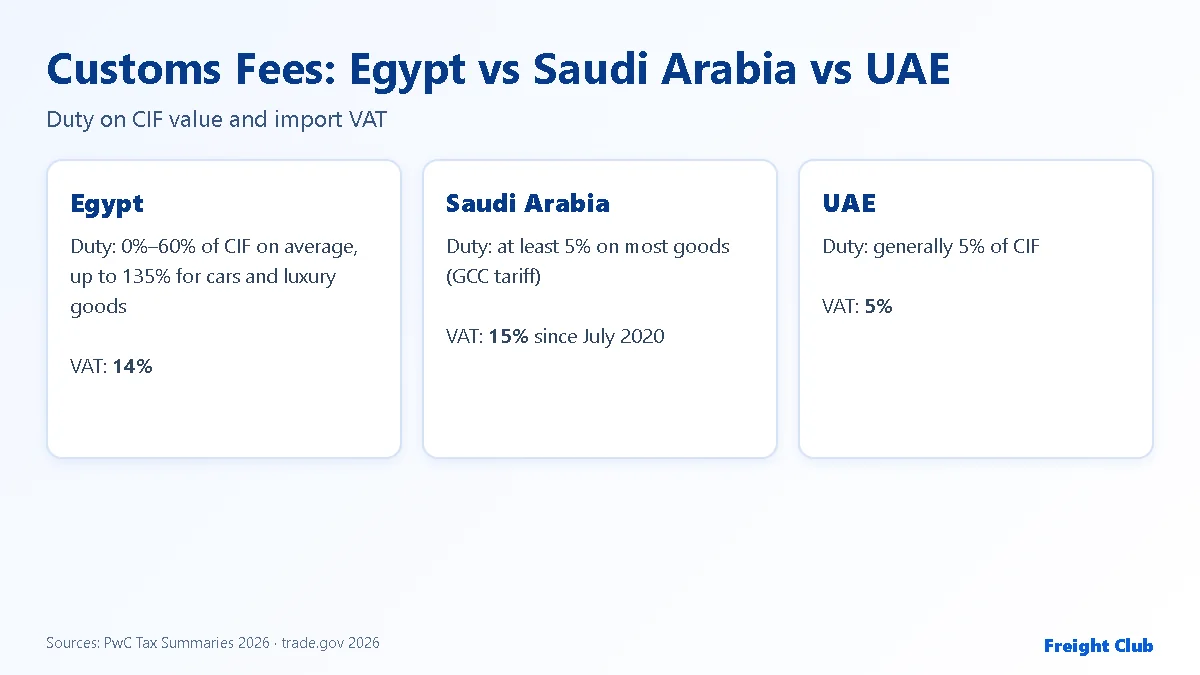
Customs fees in Egypt start with duties that average “between 0% and 60%” of CIF value, with up to 135% on passenger cars and luxury goods, and VAT of 14% on a base that includes CIF value and duty, according to PwC (reviewed August 2026). Import paperwork runs through Nafeza and the ACID system explained in ACID Number in Egypt, and service providers are compared in customs clearance in Egypt.
Customs fees in Saudi Arabia follow the GCC tariff of “at least five percent” on most goods, calculated on CIF value, with VAT at 15% since July 2020, per trade.gov (May 2026). Some food lines now carry 5% to 15% after a June 2026 tariff update reported by EY. ZATCA offers a free official customs duties and tax calculator.
Customs fees in the UAE are generally “a customs duty rate of 5%” on CIF value, and the general VAT rate is 5%, according to PwC (reviewed September 2026). For brokers and services there, see customs clearance services in the UAE.
Customs broker fees are not set by any customs authority, so no official average exists. Each customs broker prices per declaration, per shipment or as part of a door-to-door quote. That is why the government part of the bill should match between quotes while the service part should be compared line by line, as trade.gov separates duty from port and cargo service fees.
Freight Club lists customs clearance offices you can contact directly, such as Elkayan for Customs Clearance and Nour4Customs in Egypt and Sennar Horizoin in Saudi Arabia, plus the wider Egypt customs brokers list.
Who pays duties is decided by the Incoterm in the sales contract. Incoterms clarify “the tasks, costs and risks” of delivery between seller and buyer, as the International Chamber of Commerce explains. Under most terms the importer pays duty and VAT at destination; under DDP the seller pays them.
If a supplier offers DDP, check that the price really includes destination duty and VAT before you accept it. Freight Club’s DDP meaning guide explains what the seller must cover.
The fastest way to reduce customs clearance cost is to avoid the time-based charges, because storage and demurrage are billed per day once free time ends. Clearing quickly matters as much as the tariff; see how long customs clearance takes for realistic timelines.
Not sure who should quote which charge? See customs broker vs freight forwarder.
It is the total cost of getting imported goods released: customs duty and import VAT set by the government, plus broker, port, storage and inspection charges from service providers.
You pay the duty rate of your HS code on the CIF value, VAT on the value plus duty, and your broker’s and port’s fees. Duty is generally 5% in Saudi Arabia and the UAE and 0% to 60% in Egypt, according to PwC and trade.gov.
Egyptian import fees are customs duty, averaging 0% to 60% of CIF value and up to 135% for cars and luxury goods, plus VAT of 14% on a base that includes CIF value and duty, according to PwC, plus service charges.
There is no single amount: the government part depends on the HS code, the CIF value and the country’s VAT rate, and the service part depends on the broker and port. Use the estimator above for the government part.
The Incoterm in the sales contract decides. Under most terms the buyer pays duty and VAT at destination; under DDP the seller pays them.
Duties and taxes are paid against the customs declaration through the authority’s payment channels, usually by your customs broker, while broker and port fees are invoiced separately by each provider.
Most overpayments on customs clearance fees come from classification, valuation and delays rather than from the tariff itself.
This guide relies on tax authority summaries, government trade guides and international trade bodies.
Disclaimer: This guide is general information from Freight Club, not tax, customs or legal advice. Duty and VAT rates change by official decision and depend on the HS code and origin, so confirm the amount with the customs authority or a licensed customs broker before you ship.
Want a clear quote for your next shipment?
Browse customs clearance offices
Add your customs clearance company