


Last updated: 11 November 2026 · All figures checked against their sources.
Goods transport insurance pays for physical loss of or damage to your cargo while it moves by sea, air or road, beyond the small amount a carrier must pay by law. This Freight Club guide explains what each policy covers, how the premium is calculated, how carrier liability limits work, and how to choose an insurer in Egypt.
It is written for importers, exporters and manufacturers moving goods through Egyptian ports and airports. Every limit and rule below links to its source, and the cost section shows the calculation insurers use, so you can check any quote you receive.
It is a cargo policy that covers the value of your goods in transit, usually from the seller’s warehouse to yours. Without it, a loss at sea, in a port or on a truck is often recovered only up to the carrier’s legal limit, if at all.
Cargo passes through many hands between origin and destination: trucking, terminals, loading, the voyage or flight, discharge, storage and final delivery. Each stage adds risk of handling damage, theft, water damage or a total loss. Cargo insurance moves that financial risk to an insurer, so a single bad shipment does not wipe out your margin.
Usually not. International conventions cap what a carrier must pay per package or per kilogram, and the cap is often far below the commercial value of manufactured goods.
| Mode | Convention | Carrier liability limit | Source |
|---|---|---|---|
| Sea freight (Egypt) | Hamburg Rules | 835 SDR per package or 2.5 SDR per kg of gross weight | Steamship Mutual package limitation survey |
| Air freight | Montreal Convention 1999 | 26 SDR per kg, raised from 22 SDR on 28 December 2024 | FIATA air freight alert |
The SDR (Special Drawing Right) is an International Monetary Fund unit whose value against the dollar changes every day, so check the current rate when you compare a limit with your invoice. Even when a carrier is liable, you must prove fault and wait for the claim, and many causes of loss are not the carrier’s fault at all. The same steamship survey also notes that Hague-Visby limits may still apply to some shipments despite Egypt’s adoption of the Hamburg Rules, according to Steamship Mutual.
The premium is the insured value multiplied by a rate that the insurer sets for your cargo and route. There is no fixed public price, so the calculation matters more than any average figure.
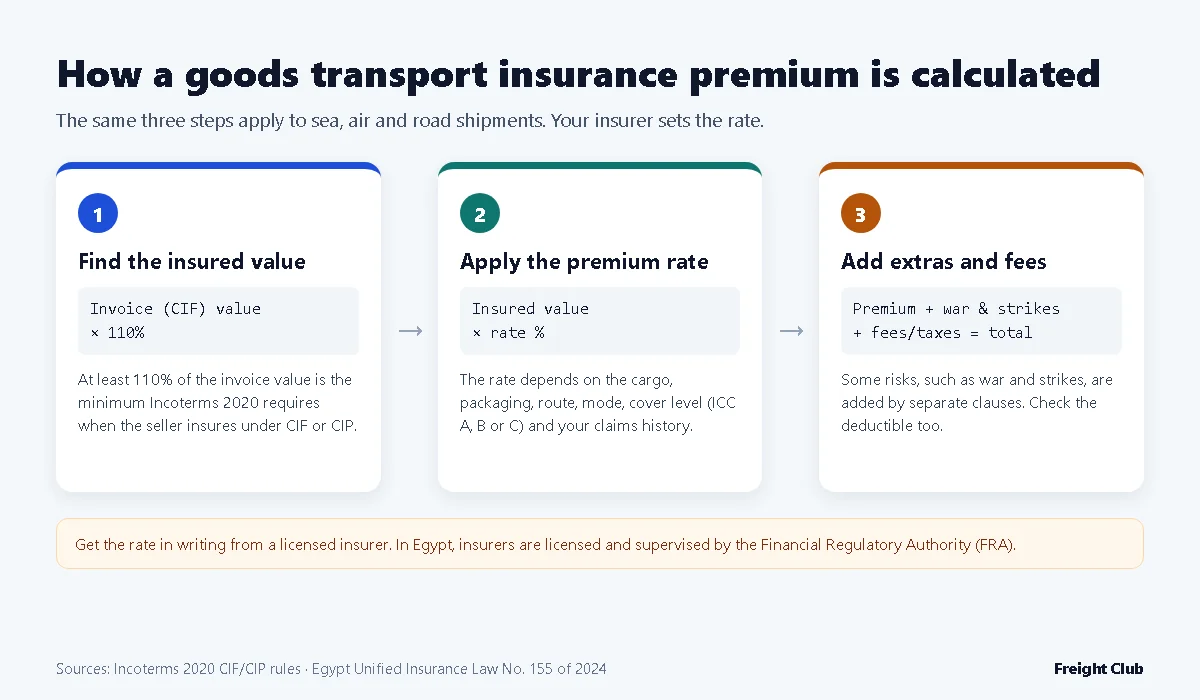
Example of the arithmetic: for goods invoiced at $50,000 on CIF terms, the minimum insured value is $55,000, which is 110% under the Incoterms 2020 CIF rule. The premium is then $55,000 multiplied by the rate in your quote. Ask every insurer for the rate, deductible and exclusions in writing so you can compare like with like.
These factors usually push the rate up or down:
To estimate the freight cost that goes into your CIF value, use the Freight Club freight rate calculator.
ICC (A) is all-risks cover with listed exclusions, while (B) and (C) only cover named perils, with (C) the narrowest. The table below summarises the comparison published by the insurer MSIG.
| Risk | ICC (A) | ICC (B) | ICC (C) |
|---|---|---|---|
| Fire or explosion; stranding, sinking or capsizing; collision | Yes | Yes | Yes |
| Overturning or derailment of land conveyance | Yes | Yes | Yes |
| General average, salvage charges and jettison | Yes | Yes | Yes |
| Earthquake, volcanic eruption or lightning | Yes | Yes | No |
| Washing overboard of deck cargo | Yes | Yes | No |
| Entry of sea, river or lake water into the ship, container or store | Yes | Yes | No |
| Rain water | Yes | No | No |
| Theft, pilferage or robbery; non-delivery of a whole package | Yes | No | No |
| Malicious damage and piracy | Yes | No | No |
| Loss or damage during loading or discharge | Yes | No | No |
| Other physical loss or damage not specified and not excluded | Yes | No | No |
All three exclude delay, ordinary leakage or wear and tear, insufficient or unsuitable packing, inherent vice, and war, strike and terrorism risks unless those are added by separate clauses, according to the same MSIG comparison. It also notes that cover normally ends on delivery to the final warehouse or 60 days after discharge at the final port, whichever comes first. If your goods will wait longer in port or storage, ask for an extension before the cover expires. For the vocabulary in a policy, see our guide to cargo insurance terms explained.
Only CIF and CIP oblige the seller to buy insurance for the buyer’s risk, and they require different levels of cover. Under every other rule, check who arranges insurance before you sign.
| Incoterm | Minimum cover the seller must buy | Minimum insured amount | Source |
|---|---|---|---|
| CIF (sea and inland waterway only) | Institute Cargo Clauses (C) or similar | 110% of the invoice value | CIF summary |
| CIP (any mode) | Institute Cargo Clauses (A) or (Air) or similar | 110% of the invoice value | CIP summary |
CIF only requires the narrowest ICC (C) cover, so a buyer importing high-value goods on CIF terms often buys extra cover or asks the seller to upgrade to ICC (A). If you pay duties and delivery yourself, our guide to what DDP means in shipping explains how responsibilities shift between seller and buyer.
Policies are grouped by transport mode and by how often you ship. Most importers combine a mode-specific policy with an annual open cover once their volume grows.

Special cargo needs special terms. Ask your insurer about conditions for reefer cargo and dangerous goods before you book.
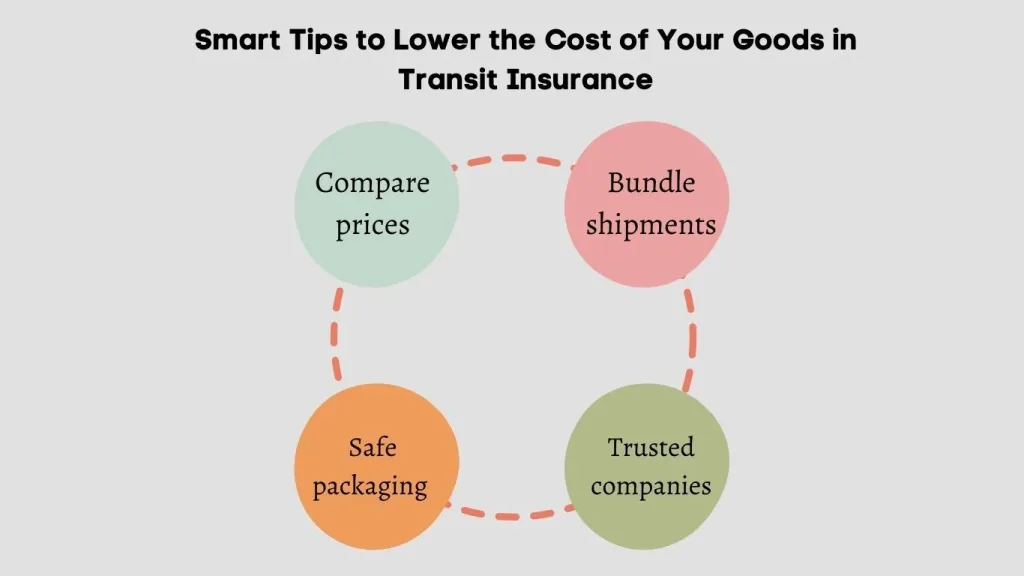
Choose a licensed insurer whose policy wording fits your cargo, route and claims needs, not only the lowest premium. In Egypt, the Financial Regulatory Authority licenses and supervises insurance companies under the Unified Insurance Law No. 155 of 2024, as shown in the FRA announcement on the Unified Insurance Law.
Compare at least two quotes on these points:
If you also ship to the Gulf, see our list of cargo insurance companies in the UAE.
Several logistics companies in the directory list cargo insurance among their services, and some legal firms handle marine cargo claims. They are listed here as described on their own profiles, not ranked or endorsed.
See the full list in the insurance and legal services category, or browse logistics companies in Egypt.
Act at delivery: note the damage on the delivery receipt, protect the goods from further loss, and notify your insurer immediately. Late notice and missing evidence are common reasons for reduced payouts.
For the full process and documents in Egypt, read our guide to cargo insurance claims in Egypt.
Usually not. Carrier liability is capped by convention, for example 835 SDR per package or 2.5 SDR per kg for sea freight under the Hamburg Rules applied in Egypt, according to Steamship Mutual. Cargo insurance covers the full insured value.
The premium is the insured value multiplied by the insurer’s rate. Under CIF and CIP, the insured value must be at least 110% of the invoice value, according to this Incoterms 2020 CIF summary.
ICC (A) covers all risks except listed exclusions, including theft and rain water. ICC (B) and (C) cover only named perils, and (C) is the narrowest, covering major events such as fire, sinking, collision, general average and jettison.
No. Delay is excluded under Institute Cargo Clauses (A), (B) and (C), so financial loss from a late arrival is not covered unless your policy specifically adds it.
Under the Montreal Convention 1999, the limit is 26 SDR per kilogram from 28 December 2024, up from 22 SDR, according to FIATA.
The Financial Regulatory Authority (FRA) licenses and supervises insurance companies in Egypt under the Unified Insurance Law No. 155 of 2024.
Goods transport insurance costs far less than a single uninsured loss. Insure at least 110% of the invoice value, as the Incoterms 2020 CIP rule requires, choose ICC (A) for valuable cargo, read the exclusions, and keep your claims documents ready. Freight Club helps you find logistics partners who can arrange cover and handle your shipments end to end.